When What You Really Want Is Peace
Last night, I had a dream.
I woke up to a bank notification telling me I had been paid £10,000,000.
For a few blissful moments, it felt real.
The relief washed over me instantly. My mind raced ahead. The possibilities seemed endless. The pressure was gone.
Then I actually woke up.
I checked my banking app, and reality quickly returned.
At first, I laughed at myself. But as the day went on, I realised the dream wasn't really about money.
It was about freedom.
It was about security.
It was about finally feeling safe.
The Cost of Living in Survival Mode
When you've spent years fighting for stability, your definition of success changes.
You don't dream about yachts, designer handbags, or luxury cars.
You dream about breathing.
You dream about not having to calculate every risk.
You dream about relationships that feel safe instead of unpredictable.
You dream about waking up without a sense of dread sitting quietly in your chest.
For those who have spent much of their lives in survival mode, peace becomes the ultimate luxury.
Not because it's extravagant.
But because it's been so rare.
When Life Becomes a Series of Battles
Some people move through life with a sense of security that has always been there.
Others learn from an early age that nothing is guaranteed.
Financial instability.
Difficult relationships.
Loss.
Disappointment.
Repeated experiences that teach you to stay alert because the next challenge is always around the corner.
Over time, that vigilance becomes a way of life.
You become strong because you have to.
Resilient because there is no alternative.
Independent because relying on others often comes with a cost.
From the outside, people admire your strength.
What they don't always see is how tired you are.
The Desire to Finally Rest
There comes a point where the dream is no longer about having more.
It's about carrying less.
Less anxiety.
Less pressure.
Less responsibility for everyone else's behaviour.
Less fear that everything you've built could disappear overnight.
You don't want a perfect life.
You don't need endless excitement.
You simply want enough stability to rest.
Enough security to trust tomorrow.
Enough peace to experience life instead of constantly surviving it.
Learning to Believe Something Better Is Possible
One of the hardest things about spending years in fight-or-flight is learning that life doesn't always have to be a struggle.
When struggle becomes familiar, peace can feel almost impossible to imagine.
Yet hope survives.
It survives in dreams.
In goals.
In quiet moments where you allow yourself to imagine a different future.
Not because you're naïve.
But because some part of you still believes that what you've always needed is possible.
A Different Kind of Wealth
The older I get, the more I realise that true wealth isn't always measured by numbers in a bank account.
It's measured by:
The ability to sleep peacefully.
Relationships that feel safe.
A nervous system that isn't constantly on high alert.
Knowing your needs will be met.
Having the freedom to be yourself without fear.
Those things are priceless.
And perhaps that's what my dream was really showing me.
Not a fortune.
But a longing.
A longing for the freedom, security, and peace that I've spent much of my life searching for.
And despite everything, I still believe it's coming.
The Quiet Reset
"Sometimes the greatest dream isn't wealth. It's finally feeling safe enough to rest."
Believe What You See: The Cost of Ignoring Misalignment
One of the most difficult lessons in life is accepting that not everyone who enters our lives is meant to stay.
When we first meet people, we naturally want to see the best in them. We extend understanding, offer patience, and allow room for imperfections. After all, every one of us has difficult seasons. We all have moments where stress, grief, disappointment, or personal struggles can influence how we show up in the world.
Giving people grace is a beautiful quality.
But there is a difference between giving grace and repeatedly ignoring what is right in front of you.
Many of us have experienced the internal conflict that comes when someone's behaviour doesn't sit comfortably with us. We notice the dismissive comments, the lack of accountability, the inconsistency, the disrespect for boundaries, or the values that simply don't align with our own.
Yet instead of trusting what we see, we explain it away.
Maybe they're having a bad week.
Maybe they're under pressure.
Maybe they're hurting.
Maybe things will get better.
So we give more time.
And then more time.
And then even more time.
What we often fail to realise is that while we are waiting for someone to become who we hope they can be, we are ignoring who they are showing us they currently are.
Patterns matter.
A single mistake does not define a person. A difficult season does not define a person. But repeated behaviour reveals something important. It tells us what someone is willing to tolerate, prioritise, and bring into a relationship.
The truth is that potential is not reality.
Many people stay in friendships, relationships, and situations because they become attached to someone's potential rather than their actions. They fall in love with who a person could be instead of accepting who they consistently are.
This creates a painful cycle.
You continue investing.
You continue hoping.
You continue explaining away your discomfort.
Meanwhile, your intuition grows louder.
That feeling in your stomach.
That hesitation before answering a message.
That exhaustion after spending time with them.
That quiet voice reminding you that something isn't right.
Your intuition is not always asking you to judge someone.
Sometimes it's simply asking you to protect yourself.
Healthy relationships do not require you to repeatedly override your own values. They do not demand that you ignore your boundaries or silence your concerns. They allow you to feel safe, respected, and aligned with who you are.
Not everyone is a bad person because they don't belong in your life.
Sometimes people are simply incompatible with the standards, values, and peace you are trying to create.
And that is okay.
One of the greatest acts of self-respect is trusting yourself enough to walk away from what no longer aligns.
You do not need endless evidence.
You do not need permission.
You do not need to wait until the damage is irreversible.
If someone's behaviour consistently leaves you feeling unsettled, unheard, disrespected, or disconnected from your values, pay attention.
Believe what you see.
Believe what you feel.
Because protecting your peace is not an act of rejection toward others—it is an act of commitment to yourself.
The cost of ignoring misalignment is often far greater than the discomfort of letting go.
And sometimes the most powerful thing you can do is accept that giving someone more time will not change who they have already shown themselves to be.
Trust the patterns.
Trust yourself.
Protect your peace.
— The Quiet Reset
How to help notice safety sooner than threat in a relationship
How to Notice Safety Sooner Than Threat in a Relationship
For some people, relationships feel exciting.
For others, relationships feel dangerous.
Not because they want them to.
Not because they are negative.
But because life has taught them that love, trust, and vulnerability often come with pain.
When you've experienced betrayal, abandonment, rejection, inconsistency, or emotional wounds, your nervous system becomes highly skilled at spotting threats. It learns to scan for warning signs before it scans for safety.
The problem is that this protective mechanism doesn't always know the difference between a genuine red flag and a healthy person moving at a different pace.
You may find yourself overanalysing texts, questioning intentions, expecting people to leave, or preparing for disappointment before it arrives.
The irony is that while your mind is searching for evidence of danger, it can completely miss the evidence of safety sitting right in front of you.
What Safety Actually Looks Like
Safety is rarely dramatic.
It doesn't usually arrive with grand gestures, intense chemistry, or constant reassurance.
Safety often looks ordinary.
It looks like consistency.
It looks like someone doing what they said they would do.
It looks like calm communication.
It looks like respect for your boundaries.
It looks like patience when you're struggling.
It looks like someone who doesn't disappear every time things become difficult.
Safety is built through repeated actions, not powerful words.
Ask Yourself a Different Question
Instead of asking:
"What could go wrong?"
Try asking:
"What evidence do I have that this person is safe?"
Not perfect.
Not guaranteed.
Safe.
Look at their behaviour over time.
Do their actions match their words?
Do they show up consistently?
Can they handle honest conversations?
Do they make you feel respected, even when they disagree with you?
These are the foundations of emotional safety.
Slow Down the Threat Response
When fear appears, pause before treating it as fact.
Fear often speaks with certainty.
It tells us:
"They're losing interest."
"They're going to leave."
"You don't matter."
But feelings are not always evidence.
Sometimes fear is simply an old wound trying to protect you from a pain that isn't actually happening in the present moment.
Before reacting, ask:
"Is this a current threat, or is this a familiar fear?"
That one question can change everything.
Allow Safety to Feel Unfamiliar
One of the hardest parts of healing is recognising that safety can feel strange.
If chaos, inconsistency, or emotional unpredictability have been normal throughout your life, calmness may initially feel boring, suspicious, or uncomfortable.
You may be tempted to search for problems because your nervous system is waiting for the other shoe to drop.
Give yourself permission to sit with the discomfort of being treated well.
Healthy relationships often feel less intense than unhealthy ones.
That doesn't mean they are less meaningful.
It means they are less exhausting.
The Goal Isn't Blind Trust
The goal is not to ignore red flags.
The goal is not to trust everyone.
The goal is balance.
To notice genuine warning signs without assuming danger everywhere.
To protect yourself without isolating yourself.
To remain aware without becoming hypervigilant.
To allow people the opportunity to earn trust while also allowing yourself the opportunity to experience connection.
Final Thoughts
Healing isn't learning how to trust people immediately.
Healing is learning how to recognise when you are safe enough to stop fighting battles that aren't happening.
It's teaching your nervous system that not every silence means rejection.
Not every delay means abandonment.
Not every relationship ends the way previous ones did.
And slowly, with time, evidence, consistency, and self-compassion, you begin to notice something beautiful:
Safety was there all along.
You just spent so many years surviving that you forgot to look for it.
The Quiet Reset
The Human Connection We Are All Craving
The Human Connection We Are All Craving…
Empathy in a World That Has Forgotten How to Slow Down
We live in a society that moves at an exhausting pace.
We are constantly connected, constantly consuming information, constantly chasing the next task, achievement, or distraction. Success is measured by productivity. Worth is often measured by what we can offer. And somewhere along the way, genuine human connection has become increasingly rare.
In a world that encourages us to move faster, empathy asks us to slow down.
Empathy is more than kindness.
It is the willingness to look beyond what is visible and to recognise that every person we meet carries a story we know nothing about. It is understanding that behind every smile may be a struggle, behind every silence may be pain, and behind every reaction may be a wound we cannot see.
The truth is that most people are fighting battles privately.
The colleague who seems distant may be carrying grief.
The friend who never asks for help may be overwhelmed.
The stranger who appears impatient may be facing challenges they never speak about.
Yet in a society that often rewards self-interest and instant judgment, we rarely pause long enough to consider what another person might be experiencing.
Instead, we assume.
We judge.
We react.
We scroll past.
Empathy challenges us to do something different.
It asks us to be curious rather than critical.
Compassionate instead of dismissive.
Present instead of distracted.
The irony is that while technology has connected us more than ever before, loneliness has become one of the defining struggles of modern life. People are surrounded by notifications, followers, and endless communication, yet many have never felt more unseen.
Sometimes what people need most is not advice.
Not solutions.
Not someone to fix their problems.
Sometimes they simply need someone willing to listen.
Someone willing to understand.
Someone willing to remind them that they are not alone.
Empathy does not always change circumstances, but it changes experiences.
A kind word may not remove someone's pain, but it can make their burden feel lighter.
A moment of understanding may not solve their struggle, but it can remind them that they matter.
And in a world where so many people feel invisible, that matters more than we realise.
The strongest people are not always those who have built the highest walls around their hearts.
Sometimes the strongest people are those who continue to choose kindness after disappointment.
Those who continue to offer compassion after being hurt.
Those who refuse to let the world make them cold.
Because empathy is not weakness.
It is courage.
It is choosing humanity in a world that often forgets it.
And perhaps if more of us slowed down long enough to truly see one another, fewer people would feel like they are carrying life's weight alone.
In a fast-paced society, empathy is not just important.
It is essential.
Because at some point in life, every one of us will need understanding.
Every one of us will need compassion.
And every one of us will hope that someone chooses empathy over judgment.
Be kind.
Be present.
Be the reason someone believes there are still good people in the world.
The Quiet Reset
The Exhaustion of Survival: When You Crave Love but Fear It Too
There’s a type of tiredness that sleep doesn’t fix.
Not the tiredness from a busy week or a difficult month.
The tiredness that comes from years of carrying everything alone.
Years of surviving.
Years of adapting.
Years of being strong because there was no other choice.
People praise resilience as if it comes without cost.
They admire independence. Strength. The ability to cope.
But they rarely ask:
What happens to someone who has spent most of their life surviving without feeling truly safe, supported or deeply loved?
Eventually, survival stops feeling like strength.
It starts feeling lonely.
And loneliness has a way of changing how we experience connection.
A new person enters your life.
They seem interesting. Maybe kind. Maybe uncertain. Maybe emotionally unavailable. Maybe not.
And suddenly, feelings arrive that seem bigger than the situation itself:
Fear.
Overthinking.
Pulling away.
Wanting reassurance.
Anger.
Need.
Shame.
Then comes the familiar question:
“What’s wrong with me?”
Maybe nothing is wrong with you.
Maybe your nervous system learned long ago that connection often came with disappointment, betrayal, inconsistency or abandonment.
So now, when something starts to matter, protection arrives first.
You question motives. Not because you want to push people away.
Because somewhere inside, there is a quieter plea:
Please don’t hurt me.
Please don’t disappear when I get scared.
Please show me I matter enough to go slowly.
Please be safe.
That isn’t a weakness.
That is a human being trying to protect old wounds.
The painful part is this:
Sometimes protection looks like distance.
You say:
“Let’s keep this professional.”
When underneath, what you mean is:
“I’m frightened. I need reassurance.”
You pull back.
Then spend days wondering:
“I ruined it?”
“I am too much?”
“Everyone will leave when they see my fear?”
And if you’ve spent years feeling unsupported, every silence starts sounding like proof:
I will always be alone, because no one will ever understand me enough for me to be seen.
But uncertainty is not proof.
Someone unknowing to your needs is not proof that you are difficult.
Your fear is not proof that you are unlovable.
Your need for depth is not proof you ask for too much.
Sometimes it simply means:
You have spent too long surviving, and your soul is exhausted.
Maybe what you are searching for isn’t just intensity.
Not just excitement.
Not someone to rescue you.
Maybe what you long for most is something much quieter:
Peace and a feeling of safety.
Someone who doesn’t rush your healing.
Someone who understands boundaries without punishment.
Someone whose presence feels like:
You can put the weight down now.
You don’t have to carry everything alone here.
The truth many survivors struggle to believe is this:
Not feeling loved is not the same as being unlovable.
And needing reassurance after years of carrying yourself is not weakness.
It is the part of you that still hopes.
The part that still believes safety might exist.
The part that hasn’t given up despite everything.
That part deserves compassion.
Not criticism.
Because surviving made you strong.
But you were never meant to survive forever.
You were meant to rest too.
Reflection question:
Have I been protecting myself from pain… or protecting myself from the possibility of finally being seen?
The Quiet Reset
I Won’t Settle for a Love That Leaves Me Feeling Alone
People don't seem to want depth anymore.
Everything feels faster now. Faster conversations. Faster attachment. Faster replacements. People want distraction, instant gratification, and temporary comfort. Something to fill the silence, avoid loneliness, soothe boredom.
And maybe that works for some.
But I have realised I can't build a life around surface-level connections.
I used to think staying single meant something was wrong with me. That may be that my standards were too high. Maybe I expected too much. Maybe I should learn to accept less.
Less communication.
Less honesty.
Less effort.
Less emotional availability.
Less consistency.
But over time, I realised those things aren't luxuries.
They are foundations.
Because wanting trust isn't unrealistic.
Wanting someone who communicates isn't asking too much.
Wanting loyalty, emotional safety, honesty and intimacy isn't impossible.
Those are the things a real connection is built on.
After experiencing betrayal, disappointment or giving too much of yourself to people who couldn't hold it carefully… your definition of love changes.
You stop craving intensity.
You start craving peace.
You stop chasing excitement.
You start looking for safety.
You stop asking:
"Do they want me?"
And begin asking:
"Can I trust them with my nervous system, my heart, my softness?"
That shift changes everything.
I've survived enough betrayal to know I can't survive abandoning myself again for the wrong person.
So no, I won't settle.
Not for inconsistency disguised as mystery.
Not for breadcrumbs mistaken as effort.
Not for feeling lonely beside someone who says they care.
Because loneliness inside a relationship can feel heavier than loneliness alone.
I'd rather wait.
I'd rather protect the parts of me that took years to rebuild.
I'd rather sit with temporary solitude than force permanence with someone who cannot meet me deeply.
And despite everything…
I still believe a deep connection exists.
I still believe some people value honesty over games, peace over chaos, loyalty over convenience.
I think those people are rare.
But rare things take time to find.
That part matters.
Because protecting your heart is understandable.
Believing no one is capable of meeting you there can become another kind of prison.
I don't want fear to become my home.
I want discernment.
I want boundaries.
I want self-respect.
But I also want to remain open enough to recognise something real when it arrives.
So maybe staying single isn't giving up.
Maybe sometimes it's choosing yourself long enough that when love comes, it doesn't require you to shrink, perform or betray who you've become.
Maybe waiting isn't loneliness.
Maybe waiting is faith.
Faith that what is meant for you won't require you to abandon yourself to keep it.
And until then—
I choose peace.
I choose depth.
I choose honesty.
And I choose not to settle.
—
The Quiet Reset
Healing. Boundaries. Depth. Becoming.
When Trust Breaks, You Learn to Protect Your Peace
This carries a lot of personal hurt, disappointment and rebuilding
When Trust Breaks, You Learn to Protect Your Peace
I gave people full access to me. My heart, my trust, my loyalty, my time. I opened my world and allowed people in, believing honesty, transparency and genuine intentions would be met with the same energy.
I gave people the benefit of the doubt because I wanted real connections. I believed in loyalty. I believed in showing up fully for the people I cared about.
Only to discover that some of those same people were lying. Pretending. Performing empathy while hiding other intentions. Sneaking around in the background, playing games, creating versions of relationships that looked strong on the outside but were built on dishonesty underneath.
I lost trust.
Not only in relationships, but in people.
Watching people manipulate, deceive and treat connection as something disposable changed me in ways I never imagined. It cut deeply because I was genuine. I was invested. I was loyal.
I thought I was building something real, only to realise I was sometimes just another piece in someone else's performance. A “power couple” image. A trophy. Validation. An option amongst many.
That kind of betrayal makes you question yourself. Your judgement. Your worth.
And for a while, I lost myself completely.
But pain teaches.
Now, I don’t give people unlimited access to me simply because they ask for it. Access is earned.
Through consistency.
Through honesty.
Through communication.
Through genuine care for who I am beneath appearances.
Because some people will say all the right things to get what they want. Attention. Validation. Entertainment. Physical connection. They’ll create an illusion of deeper intentions while keeping other options waiting in the background.
I refuse to be part of that cycle anymore.
I won’t abandon my standards just because someone offers temporary affection. I won’t trade self-worth for short-term gratification.
If someone cannot see beyond my appearance, they do not get access to my heart.
Because I am more than my looks.
I am more than a body.
I am more than someone to fill a gap when loneliness appears.
I am a human being with depth, loyalty, kindness and value.
And after losing myself, I have learned something important:
Protecting your peace is not bitterness.
Having boundaries is not being cold.
Making people earn access to you is not punishment.
It is self-respect.
And I choose self-respect now.
Always.
The Quiet Reset
The Importance of Healthy Boundaries (And How to Set Them Clearly)
In a world where people often celebrate being endlessly available, saying yes to everything, and always “showing up,” boundaries can sometimes be misunderstood as selfish or cold.
But healthy boundaries aren’t about shutting people out.
They’re about creating clear guidelines for how you allow others to access your time, energy, emotions, and personal space.
Boundaries protect your well-being, preserve your peace, and help you build relationships rooted in mutual respect—not obligation, resentment, or emotional exhaustion.
What Are Healthy Boundaries?
Healthy boundaries are the limits you set to define what is acceptable and unacceptable in your relationships, work life, and personal life. They communicate: How you expect to be treated, what you are willing and unwilling to tolerate, where your responsibilities end and another person’s begin. Boundaries can be emotional, physical, mental, financial, digital, and even conversational.
Examples include:
Not answering work messages outside of work hours
Saying no to lending money you can’t afford to lose
Refusing disrespectful communication
Protecting your alone time without guilt
Limiting access to people who drain your energy
Without boundaries, it becomes easy to overextend yourself while silently expecting others to notice your discomfort.
Most people won’t.
Not because they’re malicious—but because unspoken boundaries are invisible.
Why Boundaries Matter
1. They Protect Your Mental and Emotional Energy
Constantly giving without limits can lead to burnout, resentment, and emotional fatigue.
When you don’t protect your emotional space, you can become hyper-aware of everyone else’s needs while neglecting your own. Boundaries create balance. They allow you to give from a place of choice, not depletion.
2. They Build Self-Respect
Every time you communicate a boundary and honour it, you reinforce a message to yourself: My needs matter too. Boundaries are a practical expression of self-worth. You teach people how to treat you through what you allow, what you challenge, and what you walk away from.
3. They Improve Relationships
Contrary to popular belief, boundaries don’t ruin healthy relationships—they strengthen them.
Clear boundaries reduce confusion, assumptions, and hidden resentment.
They create clarity:
What is okay?
What isn’t okay?
What happens if a boundary is crossed?
Relationships thrive when both people know where they stand.
4. They Reduce Resentment
Resentment is often a sign of a boundary that hasn’t been communicated or enforced.
You may feel frustrated with others for taking too much, demanding too much, or expecting too much. But often, people continue patterns because no clear limit has been set. Boundaries reduce silent suffering.
Why Setting Boundaries Feels Hard
Many people struggle with boundaries because somewhere along the way, they learned that being loved meant being accommodating. You may fear:
Rejection
Conflict
Being misunderstood
Looking selfish
Disappointing others
Especially if you were praised for being “easygoing,” helpful, or self-sacrificing. But boundaries often feel uncomfortable at first because you’re changing a dynamic. People who benefited from your lack of boundaries may resist your growth. That doesn’t mean your boundary is wrong. It means the relationship is adjusting.
1. Get Clear on Your Limits
Before communicating boundaries, identify what actually feels uncomfortable or draining.
Ask yourself:
What consistently leaves me feeling depleted?
What behaviours do I tolerate but resent?
Where do I feel pressure, obligation, or guilt?
Awareness comes before action.
2. Communicate Directly and Simply
Boundaries don’t need long explanations or emotional essays. Be clear, calm, and concise.
Examples:
“I’m not available for last-minute plans.”
“Please don’t speak to me that way.”
“I can’t lend money right now.”
“I need advance notice before making commitments.”
Clarity is kinder than ambiguity.
3. Stop Over-Explaining
Over-explaining often comes from discomfort or fear of disapproval.
A boundary is not a negotiation simply because someone doesn’t like it.
You can be respectful without over-justifying yourself.
“No” is a complete sentence—though sometimes a softer version works better depending on the relationship.
4. Follow Through Consistently
A boundary without follow-through is just a suggestion. Consistency teaches others that your limits are real. If someone repeatedly ignores your boundaries, your response matters more than your words.
This may look like:
Ending conversations
Limiting access
Creating distance
Declining invitations
Boundaries are maintained through action.
5. Accept That Not Everyone Will Like It
Not everyone benefits from your growth.
Some people prefer unlimited access to your time, energy, and emotional labour.
Healthy people may adjust.
Unhealthy dynamics often resist.
Your job is not to be endlessly convenient.
Your job is to be aligned with what protects your well-being.
Final Thoughts
Healthy boundaries are not walls.
They are doors with locks—allowing you to choose who enters, how they enter, and what behaviour is acceptable once inside.
Boundaries are not punishment.
They are self-respect in action.
The clearer you become about your needs, values, and limits, the more peaceful your relationships and inner world become.
Because protecting your peace is not selfish.
It’s necessary.
Intention over Attention
Intention over attention
Short term sexual gratification can be damaging.
When Someone Only Wants You for Sexual Gratification
One of the biggest mistakes people make is confusing attention with genuine interest.
If someone only messages you when they want sexual gratification, avoids meaningful conversation, disappears afterwards, or only gives you attention when it benefits them physically, they are not truly interested in you as a person.
Real interest goes far beyond attraction.
When someone genuinely values you, they want to know who you are beneath the surface. They are curious about your mind, your goals, your emotions, your experiences, and your well-being. They make time to speak to you without expecting something in return. They enjoy your presence, your conversations, your humour, your energy — not just access to your body.
A person who truly cares will:
- Want meaningful conversations
- Check in on you consistently
- Care about how you feel emotionally
- Respect your boundaries
- Make an effort without always turning things sexual
- Value your time and energy
- Make you feel safe, heard, and appreciated
Unfortunately, many people underestimate how emotionally damaging short-term fake connections can be.
Being used for temporary gratification can slowly damage a person's confidence, self-worth, and mental health. Over time, it can leave people feeling disposable, emotionally drained, and questioning their value. It creates the feeling of being seen as an object rather than a human being with emotions, depth, and needs.
Sometimes the damage is not immediate. It builds quietly.
You start wondering why someone only reaches out late at night.
Why conversations lack depth.
Why do you feel empty afterwards instead of fulfilled?
Why does the connection feel one-sided?
The truth is: inconsistency, emotional unavailability, and transactional affection can deeply affect a person's emotional well-being.
This is why protecting your peace matters.
Not every connection deserves access to you.
Learning to value yourself means recognising when someone only wants temporary access rather than a genuine connection. It means understanding that loneliness should never convince you to accept disrespect, emotional inconsistency, or being reduced to physical value alone.
No connection is better than a fake connection.
Temporary validation is never worth long-term emotional damage.
The right people will never make you question whether you matter to them. They will show interest through consistency, effort, respect, communication, and emotional presence.
Ways to avoid these situations and value yourself more:
- Pay attention to consistency, not words
- Notice if every conversation becomes sexual
- Stop excusing bare minimum effort
- Set boundaries early
- Do not ignore how someone makes you feel emotionally
- Walk away from one-sided connections
- Build self-worth outside of relationships and attention
- Understand that your value is not based on who desires you physically
You deserve connections that make you feel respected, emotionally safe, appreciated, and genuinely cared for.
Never lower your standards just because someone gives you attention.
Real connection should leave you feeling valued — not used.
The Quiet Reset
Self-Guided Strategies for Nervous System Regulation
1. Practice Regulating Breathwork
Breathing is one of the quickest ways to communicate safety to the nervous system.
Try:
Inhale for 4 seconds
Exhale slowly for 6–8 seconds
Repeat for 2–5 minutes
Longer exhales help activate the parasympathetic nervous system, which supports rest and recovery.
2. Ground Yourself Through the Senses
Grounding techniques help anchor you in the present moment when anxiety or overwhelm takes over.
Try the 5-4-3-2-1 method:
5 things you can see
4 things you can touch
3 things you can hear
2 things you can smell
1 thing you can taste
This can reduce mental spiralling and reconnect you to your environment.
3. Move Stress Through the Body
Stress is physiological, not just mental. Movement helps discharge accumulated activation.
Helpful forms of movement:
Walking outdoors
Stretching
Yoga
Dancing
Shaking out tension in the body
Movement doesn’t need to be intense to be effective.
4. Reduce Environmental Overstimulation
A dysregulated nervous system can become more sensitive to noise, clutter, screens, and constant input.
Support your system by:
Lowering screen time
Reducing unnecessary notifications
Softening lighting
Creating quiet or low-stimulation spaces
Sometimes, regulation begins with changing your environment.
5. Use Temperature to Reset the Body
Temperature shifts can support nervous system regulation.
Try:
Splashing cold water on your face
Holding something cold briefly
Taking a warm bath or shower
Wrapping yourself in a blanket or using warmth for comfort
These physical cues can help interrupt stress cycles.
6. Prioritise Safe Connection
Humans regulate through connection. Supportive relationships can help calm the nervous system.
Seek:
Emotionally safe friendships
Time with trusted family
Calm conversations
Physical affection where comfortable
Connection with pets
Co-regulation is a powerful biological tool.
7. Build Predictability Into Your Routine
The nervous system responds well to consistency.
Focus on:
Regular sleep times
Consistent meals
Morning or evening rituals
Boundaries around work and rest
Predictability can reduce the body’s need to remain hyper-alert.
8. Externalise Internal Stress
Holding everything internally can increase overwhelm.
Try:
Journaling
Voice notes
Creative expression
Writing down racing thoughts before bed
Externalising emotion creates psychological space.
9. Spend Time in Nature
Nature naturally encourages slower rhythms.
Benefits may include:
Lowered cortisol
Improved mood
Reduced mental fatigue
Greater emotional grounding
Even 10–20 minutes outdoors can be supportive.
Regulation Is a Practice, Not a Quick Fix
Healing a dysregulated nervous system rarely happens overnight. The goal is not to eliminate stress entirely, but to increase your ability to return to safety after stress occurs.
Small, repeated actions teach the body that safety is possible again.
Over time, these moments of regulation build resilience, emotional steadiness, and a stronger connection to yourself.
Stress may be part of life—but living in survival mode doesn’t have to be your baseline.
The Quiet Reset
Improving Emotional Regulation
Learning how to respond to life without losing yourself in it
Emotional regulation is not about becoming emotionless. It’s about learning how to feel deeply without letting those feelings completely control your reactions, relationships, or sense of self.
For many people, emotional regulation was never taught. Some grew up around chaos, criticism, silence, emotional neglect, or unpredictable behaviour. Others learned to suppress everything just to survive difficult environments. Over time, emotions can begin to feel overwhelming, confusing, or even unsafe.
The result?
People either explode, shut down, overthink, avoid, cling, detach, or self-destruct emotionally — often without fully understanding why. Improving emotional regulation is not about perfection. It’s about creating enough inner stability that your emotions stop running your life.
What Emotional Dysregulation Can Look Like
Emotional dysregulation is not always dramatic. Sometimes it looks quiet and internal.
It can look like:
Overthinking every conversation
Feeling rejected very quickly
Struggling to calm down after conflict
Taking things personally
Emotional numbness
Shutting people out
Seeking constant reassurance
Mood swings
Reacting impulsively
Becoming emotionally dependent on validation
Avoiding difficult conversations
Feeling emotionally exhausted all the time
Many people think they are “too sensitive” when in reality their nervous system has simply spent too long in survival mode.
Emotional regulation starts in the body. You cannot think your way out of every emotional response. The body remembers stress, trauma, rejection, abandonment, criticism, and emotional inconsistency. When something triggers those old feelings, your nervous system reacts before logic even catches up.
This is why emotional regulation often begins with physical awareness:
Slowing your breathing
Grounding yourself
Stepping away before reacting
Sleeping properly
Eating consistently
Reducing overstimulation
Spending less time in emotionally draining environments
Your nervous system needs safety before your mind can process clearly.
The Difference Between Reacting and Responding
A reaction is immediate.
A response is intentional.
Reacting usually comes from fear, pain, insecurity, or emotional overwhelm.
Responding comes from awareness.
Emotionally regulated people still get hurt. They still feel anger, disappointment, sadness, jealousy, and frustration. The difference is that they do not allow temporary emotions to permanently damage relationships, opportunities, or themselves.
Sometimes emotional regulation sounds like:
“I need a moment before I answer.”
“That upset me, but I want to communicate properly.”
“I don’t want to react from anger.”
“I’m triggered right now, so I need space to calm down.”
That is emotional maturity.
Why Social Media Makes Regulation Harder
Modern life constantly overstimulates emotions.
People compare themselves all day long.
Validation becomes addictive.
Attention feels like self-worth.
Conflict becomes entertainment.
Ghosting, inconsistency, and surface-level interactions create emotional confusion. Many people are emotionally dysregulated simply because they never disconnect long enough to hear themselves think. Silence feels uncomfortable because distraction has become emotional avoidance. Sometimes improving emotional regulation means reducing access to things that constantly disturb your peace.
Healing Requires Self-Awareness
You cannot regulate emotions you refuse to acknowledge.
A lot of emotional pain stays trapped because people shame themselves for having feelings at all. They minimise their hurt, suppress anger, ignore loneliness, or pretend they are unaffected. But ignored emotions do not disappear; they leak out in other ways.
Healing starts when you become honest about:
What triggers you
What drains you
What makes you feel emotionally unsafe
What patterns you repeat
What environments dysregulate your nervous system
Self-awareness is not self-judgment.
It is self-understanding.
Healthy Emotional Regulation Is Not Emotional Suppression. There is a difference between being calm and being disconnected. Some people appear emotionally “strong” simply because they learned to shut everything down. But suppressed emotions eventually surface through burnout, anxiety, resentment, numbness, or emotional breakdowns.
Healthy regulation means:
Feeling emotions without drowning in them
Communicating honestly
Taking accountability for reactions
Creating boundaries
Knowing when to pause
Allowing yourself to be vulnerable safely
Real strength is emotional balance, not emotional avoidance. Small things that improve emotional regulation. Healing does not always happen through massive breakthroughs. Sometimes it happens through small repeated habits.
Things that genuinely help:
Journaling emotions instead of bottling them up
Taking breaks before responding emotionally
Therapy or emotional support
Limiting toxic environments
Exercising regularly
Sleeping properly
Spending time offline
Practicing self-awareness
Learning healthy communication
Building emotionally safe relationships
Progress often looks slow until one day you realise situations that once destroyed you no longer control you.
Final Thoughts
Improving emotional regulation is one of the most important forms of self-respect. Because when you learn how to regulate your emotions:
You stop abandoning yourself for approval
You stop reacting to unresolved pain
You stop chasing chaos that feels familiar
You protect your peace more carefully
You build healthier relationships
You become emotionally safer for both yourself and others
And perhaps most importantly…
You finally stop treating your emotions like enemies and start understanding them as signals that deserve care, attention, and compassion.
The Quiet Reset
Why I Chose Celibacy After Traumatic Relationships
Waiting for a Love That Feels Safe
There comes a point after enough heartbreak, betrayal, emotional confusion, or feeling unsafe in love, where your soul stops craving attention and starts craving peace.
That is why I chose celibacy after traumatic relationships.
Not because I stopped feeling deeply.
Not because I stopped wanting love or intimacy.
But because I finally understood that intimacy without emotional safety can leave wounds that take years to heal.
We live in a world where connection has become increasingly disposable. Modern dating often encourages people to consume each other quickly — emotionally, physically, mentally — without ever truly learning how to hold another person with care. Relationships are treated as temporary experiences instead of sacred bonds. Loyalty is rare. Patience is rare. Emotional depth is rare.
And for people who love deeply, this reality can become incredibly damaging.
After experiencing relationships that created trauma instead of safety, I realised I could no longer keep giving pieces of myself to surface-level connections that were never built to last.
I do not want half-hearted love.
I do not want inconsistent energy, emotional games, mixed signals, or people who only show up when it benefits them. I no longer romanticise intensity without stability. Chemistry without trust means nothing to me now.
What I crave is depth.
The kind of connection where silence feels safe instead of uncomfortable.
Where communication is honest instead of manipulative.
Where affection is intentional instead of transactional.
Where loyalty is natural instead of negotiated.
Where love feels peaceful instead of emotionally exhausting.
I want the kind of relationship where two people protect each other’s peace instead of becoming the reason it disappears.
That is why celibacy became more than abstinence for me. It became protection.
Healing.
Discipline.
Self-respect.
A boundary.
A refusal to abandon myself just to avoid loneliness.
People often misunderstand celibacy, especially in a culture that constantly pressures people to seek validation through attention, sex, or relationships. Some assume it comes from fear. Others assume bitterness.
But sometimes celibacy is wisdom.
Sometimes it is the result of finally understanding the emotional consequences of giving your body, mind, and vulnerability to people who never truly valued your heart.
When you have experienced emotional chaos, inconsistency, betrayal, manipulation, or relationships that made you feel mentally unsafe, your perspective changes. You stop searching for excitement alone and start searching for nervous system safety.
You begin craving softness. Stability. Presence. Emotional maturity. Peace.
And once you discover how valuable peace is, it becomes impossible to settle for relationships that disturb it.
I know my boundaries are high now.
But they had to become high because the cost of low boundaries was too painful.
I no longer allow easy access to me simply because someone is interested. Attraction is not enough. Attention is not enough. Words are not enough. I need emotional consistency. Integrity. Depth. Effort. Accountability.
I need to feel safe emotionally, physically, and mentally.
And that level of trust cannot be rushed.
I am firmly monogamous because my heart was never designed for fragmented intimacy. I do not connect casually. When I love, I love with intensity, loyalty, passion, and permanence. I believe love should feel like a partnership, not possession, sanctuary, not survival.
I am waiting for the person who feels like home in a destructive world.
A ride or die.
A best friend.
A life partner.
A soul connection built on trust, honesty, emotional depth, and mutual protection. Someone who matches my intensity without fearing it. Someone who values peace as much as passion. Someone who understands that real love is not performance — it is presence.
And yes, it can feel lonely sometimes.
Because modern relationships often feel temporary. Disposable. Replaceable.
People want intimacy without responsibility.
Access without commitment.
Closeness without accountability.
Trusting becomes difficult in a world where loyalty feels increasingly rare.
But I would rather wait years for something genuine than repeatedly lose myself inside with connections that were never capable of holding my heart safely.
Because some of us are not searching for entertainment.
We are searching for one person to build a lifetime with.
And until that kind of love arrives, I will continue protecting my peace instead of settling for temporary comfort.
Because after everything I have survived, peace is no longer optional for me; it’s necessary.
It is the foundation of the love I am willing to give and accept.
Not Everyone Deserves Access to You. The Emotional Cost of Oversharing Online
We live in a time where constant visibility is normalised
People document their mornings, relationships, breakdowns, arguments, healing journeys, loneliness, achievements and insecurities in real time for strangers to consume. Social media encourages openness because openness creates engagement. The more emotional the content, the more attention it often receives. But there is a difference between expression and exposure. And many people do not realise the emotional cost of giving too much access to themselves online until the damage has already been done. The internet can make you feel seen while slowly disconnecting you from your own sense of safety, privacy and emotional peace. Because not everyone watching you is watching with good intentions.
Why Oversharing Feels Good at First
At first, social media can feel comforting. You post something vulnerable, and people respond instantly. You feel noticed. Supported. Wanted. Understood. For a moment, loneliness softens.
That reaction creates emotional reinforcement. The brain begins associating visibility with connection and validation with worth. Over time, this can create an unhealthy cycle where emotional exposure becomes tied to feeling valued.
The more personal you become online, the more attention you often receive, the more emotionally attached people become to your life, and the more pressure you feel to continue sharing. Without realising it, your private world slowly becomes public property. People begin to expect access to you; your emotions are monitored, and silence becomes questioned. Your boundaries become interpreted as rejection. This is where things start becoming emotionally dangerous.
The Illusion of Closeness
One of the biggest dangers of social media is how quickly it creates false intimacy.
Someone can watch your content every day and genuinely feel emotionally connected to you without truly knowing you at all.
They may know: Your struggles, your habits, your routines, your relationship issues, your emotional triggers, your loneliness, your insecurities. But information is not a connection, access is not intimacy, and familiarity does not automatically mean safety.
The problem is that online exposure can make strangers feel entitled to emotional access they never earned. Some people begin believing:
You owe them replies
You owe them emotional availability
You owe them explanations
You owe them consistency
You owe them personal access because they “support” you. This is where emotional boundaries online begin collapsing.
When Attention Becomes Emotional Dependency
Social media can quietly create emotionally unhealthy dynamics, not just for followers, but for the person sharing.
You may begin: Posting when you feel low just to feel reassured, seeking validation during emotional moments, measuring your worth through engagement, feeling anxious when attention drops, feeling guilty for withdrawing, feeling pressured to stay emotionally available online
This creates exhaustion because humans are not designed to constantly perform emotionally for large audiences. The more people gain access to your emotions, the harder it becomes to protect your mental and emotional energy. And unfortunately, vulnerable people often attract unhealthy attention. Not Everyone watching you wants the best for you. This is one of the hardest truths to accept online. Some people support you genuinely. Some admire you quietly. Some relate to your story in healthy ways. But others are drawn to vulnerability for the wrong reasons. Some people:
Enjoy emotional dependency
Become possessive over your attention
Project fantasies onto you
Feel jealous of your happiness
Watch silently while waiting for you to struggle
Use personal information against you later
Feel entitled to control or influence your emotions
The internet gives strangers unprecedented access to people’s emotional lives, and sadly, empathy is not universal. Not everyone consuming your vulnerability values it responsibly. The emotional consequences of too much access over time, oversharing, can deeply affect mental well-being. You may begin feeling:
Emotionally exposed
Hyperaware of other people’s opinions
Drained from constant interaction
Unable to switch off mentally
Anxious when not posting
Misunderstood by people who only know fragments of you
Emotionally unsafe online
You may also notice that real-life relationships begin suffering, because when too much emotional energy is poured into maintaining online visibility, there is often less left for genuine connection offline. The internet can create the illusion of closeness while leaving people emotionally isolated in reality.
Boundaries Are Not Cruel
Many empathetic people struggle with boundaries because they fear disappointing others. But boundaries are not rejection. They are protection. Healthy people respect limits. Unhealthy people resent them.
You are allowed to:
Stop replying constantly. Keep parts of your life private. Share less. Disappear for a while. Protect your emotional energy. Change what people have access to. Privacy is not dishonesty. And protecting your peace is not selfishness. Not every thought needs posting. Not every wound needs public witnessing. Not every emotion needs audience validation. Some parts of your life deserve safety, silence and real-world care.
How To Protect Yourself Online
1. Stop Posting From Emotional Vulnerability
The moments you feel most emotional are often the moments you need privacy the most. Not performance and not public reassurance.
Give yourself time before sharing emotional experiences online.
2. Separate Validation From Connection
Attention can feel comforting, but attention is not the same as love, care or emotional safety.
Real connection exists beyond algorithms and engagement.
3. Let People Earn Access Slowly
Not everyone deserves immediate emotional access to your inner world.
Trust should be built gradually — online and offline.
4. Keep Parts of Your Life Sacred
The healthiest people usually protect parts of themselves from public consumption.
Not everything meaningful needs an audience.
5. Learn To Disconnect Without Guilt
You do not owe constant availability to people on the internet.
Rest is healthy.
Privacy is healthy.
Silence is healthy.
Final Thoughts
The modern world rewards exposure, but peace often lives in what you choose not to share.
The people who truly care about you will respect your boundaries, your privacy and your humanity outside of social media. Because a real connection does not demand unlimited access, and the strongest form of self-respect is learning that not everyone deserves front-row seats to your inner world.
The Quiet Reset
The Breaking Within The Softness
There are people in this world who carry softness in a way others never understand.
The ones who check on everyone else while silently falling apart themselves.
The ones who listen deeply, forgive too easily, love too hard, and still somehow get left questioning whether anyone truly sees them at all.
They walk through life with empathy stitched into their soul.
Not because life was always kind to them… but because they know exactly what pain feels like, and they never want another person to carry it alone.
These are the people who give without keeping score.
The people who notice the smallest changes in somebody’s voice.
Who can feel energy shift before words are spoken.
Who sit with others in darkness while hiding their own storms behind a smile.
And strangely… they are often the least understood.
Because the world celebrates loudness, performance, ego and surface-level connection.
But people with depth don’t always know how to perform.
They feel everything.
They overthink conversations.
They replay moments.
They carry emotional weight most people never notice.
They are the “strong friend.”
The dependable one.
The safe place.
The unpaid therapist.
The person everyone runs to when life hurts.
Yet when their own souls become heavy, silence is often what greets them back.
Not because they are unworthy of love.
But because compassionate people are so used to giving light away, others forget they need warmth too.
There is a particular loneliness that comes from being emotionally intelligent in a world that mostly consumes rather than understands.
A pain in knowing you can love people deeply, see the good in them, hold space for their flaws… while rarely receiving that same emotional depth in return.
Some people will love your kindness, but never protect your heart.
Some will lean on your empathy while draining your spirit.
Some will enjoy being understood by you while never taking the time to truly understand you back.
And that hurts more than many admit.
Because people with deep souls are not asking for perfection.
They are asking to be seen.
Seen beyond what they do for others.
Seen beyond being “strong.”
Seen beyond how useful they are.
They want someone to notice the tiredness behind their smile.
To ask if they are okay and genuinely wait for the real answer.
To love them with the same tenderness they naturally pour into everyone else.
The truth is, compassionate people often carry invisible grief.
Grief from abandonment.
Grief from feeling emotionally misplaced.
Grief from constantly pouring from a cup nobody thinks to refill.
But despite everything, they still love.
Still help.
Still show kindness.
Still choose softness in a world that often rewards coldness.
And that is strength.
Not weakness.
Not naïvety.
Strength.
Because staying compassionate after life has hurt you is one of the rarest things a person can do.
So if you are someone who feels unseen…
Someone who gives more than they receive…
Someone whose heart feels exhausted from carrying everyone else…
Please remember this:
Your depth is not too much.
Your empathy is not a flaw.
And one day, the right people will recognise the kind of soul you are without you having to beg to be understood.
Until then, protect your energy.
Stop shrinking your heart to fit emotionally unavailable people.
And never apologise for being the kind of person this world desperately needs more of.
The Quiet Reset
The Judging of a book by its cover
The Judging of a book by its cover.
Why Some Women Dislike You Before They Even Know You
There’s a strange kind of loneliness that comes from being judged before you’ve even spoken.
Some women walk into a room and are instantly welcomed.
Others walk in and can feel the energy shift before a single word is exchanged.
The looks.
The assumptions.
The coldness disguised as “vibes.”
The silent competition you never signed up for.
And the hardest part?
Most of the time, it has nothing to do with who you actually are.
Sometimes people judge confidence as arrogance.
Beauty as a threat.
Quietness as attitude.
Independence as being “too much.”
People create stories about you based on appearance, presence, social media, the way you carry yourself, or even the attention you receive from others. They decide who you are before giving you the chance to show them.
Not because you harmed them.
But because your existence triggers something unresolved inside them.
That truth can be painful when you’re someone who genuinely leads with kindness.
The Reality No One Talks About
Women are often conditioned to compare themselves to each other from a young age.
Who looks better.
Who gets more attention.
Who seems happier.
Who is more confident.
Who is more desired.
Social media has amplified it even more.
People scroll through filtered snapshots of each other’s lives and start projecting insecurity, resentment, jealousy, or assumptions onto strangers they’ve never actually met.
And when someone already struggles with their own self-worth, they may instantly dislike anyone who reflects back something they feel they lack.
Not because you did anything wrong.
But because your confidence, healing, peace, or authenticity makes them uncomfortable.
Stop Shrinking Yourself to Make Others Comfortable
One of the biggest mistakes people make is trying to become smaller so they’re easier to accept.
They dim their light.
Over-explain themselves.
Act less confident.
Hide achievements.
Tone down their appearance.
Stay silent to avoid making others uncomfortable.
But no matter how much you shrink yourself, people committed to misunderstanding you will still do it.
You cannot heal someone else’s insecurity by abandoning yourself.
How to Deal With This Kind of Energy
1. Don’t Internalise Every Reaction
Not everybody’s opinion is a reflection of your character.
Some reactions come from projection, insecurity, past experiences, or silent comparison.
You don’t need to carry energy that was never yours to begin with.
2. Stop Chasing Validation
The moment you stop needing everybody to like you, you become free.
Not everyone will understand your heart, your intentions, or your journey — and that’s okay.
Your value does not decrease because someone decided to misjudge you.
3. Protect Your Energy Without Becoming Bitter
There’s a difference between having boundaries and becoming hardened.
Stay kind.
Stay respectful.
But stop forcing connections where the energy feels heavy, fake, competitive, or draining.
Not every room deserves access to you.
4. Let People Be Wrong About You
This one takes real healing.
You don’t always need to defend yourself, explain yourself, or prove your softness to people determined to see you through a distorted lens.
Sometimes peace comes from allowing people to misunderstand you while you continue living authentically anyway.
5. Focus on Genuine Connections
The right people won’t compete with you.
They won’t resent your happiness.
They won’t secretly hope you fail.
Real connections feel safe. Calm. Mutual.
Those people exist — even if they feel rare in today’s world.
Final Thoughts
Being disliked before being known can make you question yourself deeply.
But never let other people’s projections convince you that you need to become less of yourself to be accepted.
Some people will misunderstand your confidence.
Some will resent your peace.
Some will judge your appearance before your character.
Let them.
The people meant for you will always take the time to know your heart instead of creating a story about you from a distance.
The Quiet Reset
A Friend Or Foe
knowing who to trust when trying to live in a peaceful era. Friend or Foe?
Knowing who to trust when you’re trying to live in a peaceful and quiet era.
There comes a point in life where you realise not everyone around you truly wants the best for you.
Some people will smile in your face, support you publicly, and speak kindly when it benefits them — yet quietly resent your growth behind closed doors. Not because you’ve harmed them, but because your progress reminds them of everything they feel they’re lacking within themselves.
That truth can be painful to accept.
Not every connection is genuine. Not every person clapping for you wants to see you win.
Some people stay close because they want access, control, or influence over your life. They become uncomfortable when you begin healing, building confidence, creating new opportunities, or forming meaningful connections outside of them. The moment you start evolving, they begin pulling in subtle ways — planting doubt, creating tension, discouraging your ideas, or making you feel guilty for changing.
Growth exposes people.
The hardest part is that these behaviours are rarely obvious at first. Manipulation often hides behind concern. Jealousy hides behind jokes. Control hides behind loyalty. And resentment often hides behind fake support.
But eventually, energy never lies.
You begin noticing how certain people react when good things happen for you. You notice who celebrates your growth and who competes with it. You notice who drains your spirit after every conversation and who genuinely pours into your life.
People who truly care about you will never fear your evolution. They won’t want to hold you back. They won’t try to isolate you from new friendships, opportunities, or happiness. They won’t resent your healing.
Secure people inspire growth in others. Insecure people fear it.
And the important thing to remember is this: Their behaviour is not a reflection of your worth.
People act from the place they are internally living in. Someone filled with resentment will project resentment. Someone battling insecurity will often try to diminish the confidence in others. Someone unhappy within themselves may struggle to watch another person rise.
That is not your burden to carry.
Your responsibility is protecting your peace, trusting your intuition, and learning to stop ignoring the red flags simply because you see potential or goodness in people.
A quiet reset in life often requires distance from those who secretly benefit from your self-doubt.
Not everyone deserves access to your energy. Not everyone deserves your loyalty. And not everyone is meant to walk into the next chapter with you.
The right people will never fear your light. They’ll help you shine brighter.
The Quiet Reset
Mental Health Strategies in a World Full of Opinions
We live in a world where everyone has something to say.
Social media gives people instant access to our lives, our choices, our appearance, our healing, our success, and even our struggles. Opinions are shared faster than empathy, and criticism has become normalised in ways that can quietly impact mental health more than people realise.
The truth is, not everybody will understand your journey. And not everybody is meant to.
One of the biggest forms of emotional growth is learning how to protect your peace in a world that constantly tries to pull you into noise, comparison, judgment, and negativity.
Why Other People’s Opinions Affect Us So Deeply
As human beings, we are wired for connection and acceptance. Rejection, criticism, gossip, or feeling misunderstood can activate stress responses within the body — especially for people who have experienced trauma, anxiety, burnout, or long-term emotional pressure. Over time, constantly absorbing negativity can lead to:
Mental exhaustion
Heightened anxiety
Emotional overwhelm
Nervous system dysregulation
Self-doubt
Hypervigilance
Burnout
Many people appear “fine” on the outside while internally carrying stress levels their body was never designed to hold long-term.
This is why protecting your mental and emotional well-being is no longer a luxury. It is essential.
The Reality of Modern Life
Life today moves fast.
People are balancing financial pressure, family responsibilities, work stress, emotional struggles, social comparison, and constant digital stimulation — often all at the same time.
And at that same time, we are expected to:
Stay productive
Always be available
Keep smiling
Keep pushing
Keep coping
But the human nervous system was never built for endless pressure without rest. Sometimes, overwhelm is not weakness. Sometimes it is simply a sign that your mind and body need support.
Mental Health Strategies That Actually Help
Healing is not always about dramatic transformation. Often, it is about small daily practices that help bring your nervous system back to safety and balance.
1. Protect Your Energy
Not every opinion deserves access to you.
You do not need to explain yourself to people committed to misunderstanding you. Boundaries are not selfish — they are necessary. Sometimes protecting your peace means:
Logging off social media
Limiting access to draining people
Stopping over-explaining
Choosing silence over conflict
Peace is powerful.
2. Slow Down Without Guilt
Rest is not laziness.
Many people only allow themselves to stop once they are completely burnt out, emotionally overwhelmed, or physically unwell. Learning to slow down before reaching that point is an act of self-respect.
Your worth is not measured by constant productivity.
3. Stop Absorbing Every Opinion
People project from their own experiences, wounds, insecurities, and perceptions.
Not all criticism is true.
In a world where everyone has a platform, emotional resilience comes from learning the difference between:
Helpful feedback
Noise
Projection
Jealousy
Misunderstanding
You do not need validation from strangers to validate your life.
4. Regulate Your Nervous System
Mental health is deeply connected to the body.
Simple grounding practices can help calm overwhelm:
Deep breathing
Walking
Time in nature
Reducing overstimulation
Sleep and hydration
Creating quiet moments during the day
Sometimes healing starts with teaching your body that it is safe again.
5. Focus on Authentic Connection
We live in a hyper-connected world where genuine connection can still feel rare.
Protect relationships that feel:
Safe
Honest
Reciprocal
Supportive
Calm
A real connection should not leave you emotionally depleted.
Choosing Peace in a Loud World
Not everyone will like you.
Not everyone will understand your healing.
Not everyone will clap for your growth.
And that is okay.
Your job is not to carry the weight of everybody else’s opinions. Your job is to protect your mental well-being, honour your healing, and continue becoming the person you are meant to be.
Sometimes the strongest thing you can do is:
Stay grounded
Stay authentic
Move quietly
And let life speak for itself
Because in a world full of noise, choosing peace is a form of power.
The Quiet Reset
The Strength of a Soft Heart: Why Boundaries Matter
The Strength of a Soft Heart:
Why Boundaries Matter
The Strength of a Soft Heart:
Why Boundaries Matter
There is something beautiful about people who lead with empathy.
The ones who listen deeply, forgive easily, and try to understand the pain behind people’s actions instead of immediately judging them. The people who love hard, care genuinely, and carry compassion into a world that often lacks it.
But sometimes, the very qualities that make someone beautiful also make them vulnerable.
When you are deeply empathetic, it becomes easy to overextend yourself for others. You begin giving chances that were never earned. You tolerate behaviour that quietly hurts you because you understand why someone acts the way they do. You excuse disrespect because you can see someone’s wounds. You carry emotional weight that was never yours to hold.
And over time, if you are not careful, compassion without boundaries becomes self-abandonment.
There is a difference between being kind and allowing yourself to be used.
There is a difference between understanding someone and continuously accepting behaviour that drains, disrespects, or devalues you.
A good heart should never require self-destruction.
The truth is, boundaries are not cold.
They are not cruel.
They are not selfish.
Boundaries are an act of self-respect.
They are the quiet decision to protect your peace, your energy, your emotional wellbeing, and your self-worth. They are recognising that you can love people while also refusing to tolerate behaviour that harms you.
You can be compassionate and still say:
“No more.”
“This is not healthy for me.”
“I deserve better than this.”
“I will not continue to explain my worth to people committed to misunderstanding it.”
One of the hardest lessons empathetic people learn is that not everyone values kindness in the same way. Some people appreciate it. Others expect it endlessly. And some will take from you for as long as you continue giving.
That is why boundaries matter.
Not because you stop loving people — but because you finally start loving yourself too.
Walking away from disrespect does not make you bitter.
Saying no does not make you difficult.
Protecting your peace does not make you selfish.
It makes you emotionally healthy.
There comes a moment in healing where guilt must stop controlling your decisions. A moment where you realise that constantly sacrificing yourself to keep others comfortable is not loyalty — it is emotional exhaustion disguised as kindness.
You are allowed to disappoint people if it means staying true to yourself.
You are allowed to choose peace over chaos.
You are allowed to stop carrying relationships that only survive through your effort.
Real love, real friendship, and real connection should not require you to betray yourself in order to keep them.
The strongest people are not always the loudest or hardest. Sometimes strength looks like softness with standards. A heart that remains compassionate without allowing the world to walk all over it.
Because the goal is not to stop loving deeply.
The goal is to love deeply without losing yourself in the process.
The Quiet Reset
Creating a Calm Home Environment
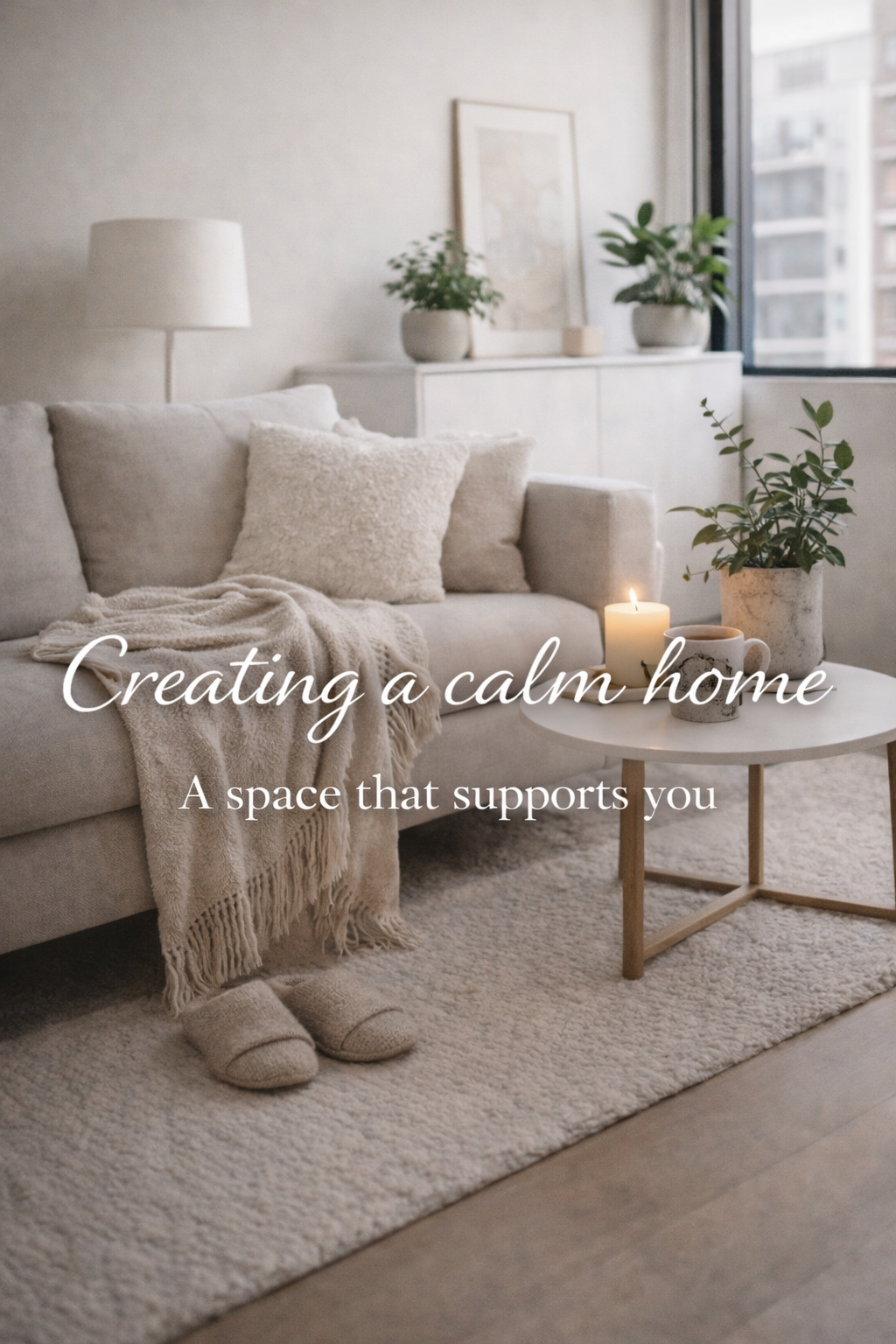
Creating a Calm Home Environment: A Space That Supports You
Creating a Calm Home Environment: A Space That Supports You.
Your home should feel like a place you can breathe. Not somewhere that adds to the noise. Not somewhere that overwhelms you. But a space that feels calm. Safe. Restorative. Because the environment you live in… shapes how you feel every day.
Why Your Environment Matters
When your space feels chaotic, your mind often follows. Clutter. Noise. Constant distractions. It all adds to that underlying feeling of overwhelm. But when your space feels calm, something shifts.
You feel:
More grounded
More settled
More able to think clearly
Your home becomes a place that supports you, not drains you. It’s Not About Perfection. Creating a calm home isn’t about having a perfect house. It’s not about expensive décor or everything looking like a magazine. It’s about how your space feels.
Simple.
Clear.
Comfortable.
A place where you can relax without pressure. Start with Small Changes. You don’t need to change everything at once. Start with one area.
Clear a surface
Open a window
Add a candle or soft lighting
Put on calming music
Small shifts can completely change the atmosphere of a room.
Create Moments of Calm. Your home doesn’t have to be calm all the time—life is busy. But you can create small pockets of peace. A quiet corner with a blanket and a drink, a space to sit without distractions, a moment in the morning before the day begins. These moments matter. They give your mind space to reset. Reduce What Drains You. Sometimes creating calm isn’t about adding more. It’s about removing what feels heavy. Decluttering items you don’t need, turning off background noise Letting go of things that feel overwhelming. Less really can feel like more. Bring in What Feels Good. Think about what makes you feel calm. Natural light, soft textures, Neutral tones, Plants or nature
Your home should reflect what you need— not what anyone else expects. A Space That Works With You. Your home should support your life, not add pressure to it. It doesn’t need to be perfect. It just needs to feel right. A space where you can: Rest, Reset, and come back to yourself.
A Quiet Reminder
You don’t need to escape your life to find peace.
You can create it… right where you are.
In the small moments.
In the quiet corners.
In the way you choose to shape your space.
Because calm isn’t something you find.
It’s something you create.
The Quiet Reset
Rebuilding Yourself After Burnout
Burnout doesn’t happen overnight. It builds quietly. Through constant pressure. Through emotional exhaustion.
Through giving more than you have to give… for far too long. Until one day, you realise: You’re tired in a way that rest doesn’t fix. What Burnout Really Feels Like. Burnout isn’t just being busy. It’s: Feeling drained before the day even begins, Struggling to focus, Losing motivation for things you once enjoyed, Feeling disconnected from yourself. It’s not a weakness.
It’s your body and mind asking for something different. You can’t Push Through Burnout For so long; we’re taught to keep going. To be strong. To push through. To not stop. But burnout doesn’t respond to pressure. It responds to care. The more you push, the heavier it feels. The more you ignore it, the louder it becomes.
Rebuilding Starts with Slowing Down. The first step isn’t doing more. It’s doing less. Creating space. Allowing rest. Letting your system calm down. Not forever. Just long enough to begin again—differently. Small Steps Back to Yourself. You don’t need to rebuild your life overnight. Start small. A quiet morning moment, a short walk outside, saying no to one thing that drains you, drinking water, moving your body gently, permitting yourself to pause.
These small actions matter more than you think.
Let Go of Who You Had to Be. Burnout often comes from being everything for everyone. Strong. Reliable. Always available. But you’re allowed to change that. You’re allowed to: Set boundaries, rest without guilt, prioritise your wellbeing. You don’t have to keep being the version of you that got you here. Rebuilding Your Energy, Not Just Your Routine. This isn’t just about routines. It’s about your energy. What drains you? What restores you? What feels aligned.
When you start listening to that… everything shifts.
A New Way Forward: Rebuilding isn’t about going back to who you were. It’s about becoming someone who: Protects their energy, moves with intention, and lives in a way that feels sustainable, not perfect. Just better.
A Quiet Reminder
You don’t have to rush your healing.
You don’t have to have it all figured out.
You just have to start… gently.
Because burnout isn’t the end of you.
It’s the moment you realise something needs to change.
And that’s where your reset begins.
The Quiet Reset